NEW JERSEY APPLESEED STATEMENT ON PROPOSED REDISTRICTING AMENDMENT

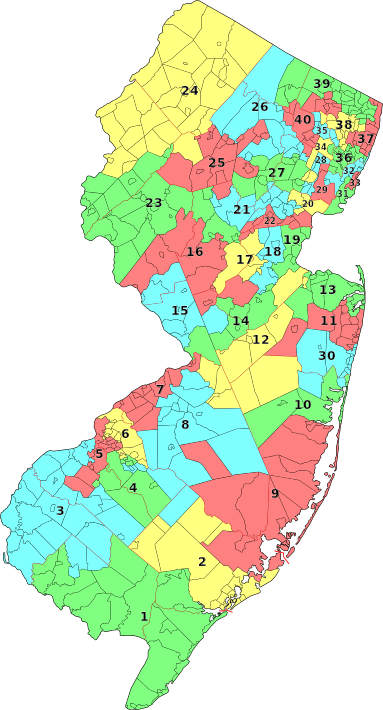
New Jersey Appleseed Public Interest Law Center today issued the following statement on the proposed constitutional amendment now pending before the Legislature (SCR152 and ACR205) that deals with how state legislative districts are drawn.

After a careful analysis of the pending proposals to alter the State’s reapportionment commission, New Jersey Appleseed has concluded that the proposal would be marginally more harmful than the status quo to the public interest, and to the interest of New Jersey voters. Nonetheless, for reasons more fully stated below, New Jersey Appleseed urges that the current proposal be rejected and that the Assembly and Senate should remand apportionment reform to an appropriate committee, for the establishment of a significantly new system that involves the creation of a citizen-based or nonpartisan commission.

The current method by which both redistricting and reapportionment are performed in New Jersey is at best characterized as minimally acceptable, but short of a just and fair system to which voters are entitled.

As it has operated to date, one political party insider from each of the two major political parties appoints other political party insiders to the reapportionment commission.  In the last reapportionment commission, in 2011, seven of the eleven members were sitting legislators.  Although the overwhelming presence of sitting legislators who have a self-interest in how districts are drawn is problematic, the current system has some protection against excesses.  Namely, because the maps proffered by each political party’s appointees must earn the support of a nonpartisan member appointed by the Chief Justice of the New Jersey Supreme Court, the map drafters are thereby deterred from offering outrageously gerrymandered maps as some other states have witnessed.  The results of this process in the past have been minimally acceptable, but they have still fallen far short of what is obtainable as a matter of fairness and justice.

New Jersey Appleseed does not find that greater diffusion in who chooses reapportionment commission members is intrinsically bad policy.   We do find it problematic, however, that the current proposal would result in the appointing authorities remaining, as is true under the current system, political insiders with a vested interest in the outcome of the map.

Nor do we find the mandate of a minimum number of competitive districts to be intrinsically flawed.  On the contrary, promoting competitive districts is a legitimate factor for the creation of responsible redistricting and reapportionment plans.  The problem with the proposed redistricting amendment is that, for the remaining districts – those not deemed to be competitive, there is no meaningful protection against them being “packed” and “cracked” in a way that would create a legislative map that is unjust – not just to political parties – but more importantly, to voters.

New Jersey can confidently look to other states that have created redistricting and reapportionment commissions that draw on experienced professionals, yet seek to minimize (though not eliminate) the role of self-interested legislators and political party insiders in the creation of maps.

While these other methods, sometimes called “citizen-based” or “nonpartisan” commissions, vary in their specifics, what they have in common is they rightly grant political parties and officeholders a full opportunity to be heard in regard to map-drawing.  However, they also ensure that legislators and legislative leadership do not serve as, nor do they appoint, a majority of the committee that actually draws the maps. Among others, California, Colorado, and Iowa all have responsible processes that minimize the influence of political party insiders, either as members of redistricting commissions, or with the responsibility of directly appointing members of these commissions.  These states’ processes provide useful templates from which New Jersey voters could obtain redistricting and reapportionment processes that have the public interest at heart, rather than the self-interest that is promoted by both the current system and the pending amendment proposals.

New Jersey Appleseed therefore urges that SCR152 and ACR205 be rejected, and the matter remanded to the appropriate Senate and Assembly Committee for a proposal that creates a citizen-based, rather than a party-based, redistricting and reapportionment system.

The above statement was prepared by New Jersey Appleseed Executive Director Renée Steinhagen and board member Flavio Komuves.

LET’S DO IT RIGHT ON NEW VOTING MACHINES

Two New Jersey towns at opposite ends of the state–Westfield, in Union County, and National Park, in Gloucester–tried out new voting machines on Election Day last week.

Both towns were part of a state pilot program paid for with federal HAVA (Help America Vote Act) Election Security Grants. New Jersey which received roughly $10 million of the $380 million national total, allocated $2.5 million for the pilot, plus another $250,000 for a related pilot to audit the votes cast on the new machines. Continue reading LET’S DO IT RIGHT ON NEW VOTING MACHINES

NEW JERSEY VOTES STILL HACKABLE

Election Day is upon us again and it is one that many of us view as crucial to saving our democracy, as we mobilize to flip control of the U.S. House of Representatives, and possibly the Senate too, so we can thwart the destructive policies of Donald Trump.

The day after last year’s election, I wrote a blog post about the vulnerability of New Jersey’s  voting machines. I am sorry to say that, although some small steps have been taken since then, our votes are still at risk, despite mounting evidence that they are not secure and that Russia hacked some states’ election systems in 2016.

New Jersey remains one of a handful of states where the validity of election results cannot be confirmed because the votes are recorded electronically and lack a verifiable paper trail.  Continue reading NEW JERSEY VOTES STILL HACKABLE

STATE INVALIDATES ANTI-DEMOCRATIC RADBURN BY-LAWS

Radburn residents who have been battling for years to have a greater say in the governance of their planned community, gained ground earlier this month when new by-laws that would have undermined their voting rights were thrown out by the state.

The NJ Department of Community Affairs (DCA) on March 2 notified the Radburn Association board that amendments it approved last May were invalid because they were never filed with the county clerk, as required by state law. As a result, Radburn members get to elect four trustees to the nine-member board rather than the two that would have been allowed under the by-law changes.

Continue reading STATE INVALIDATES ANTI-DEMOCRATIC RADBURN BY-LAWS

COMPLAINT SAYS RADBURN BY-LAW CHANGES WERE MEANT TO THWART NEW VOTING PROTECTIONS FOR PLANNED COMMUNITIES

On January 23, New Jersey Appleseed filed a complaint on behalf of Radburn United, a community group that is asking for the state’s help in preserving the voting rights of those who reside there.

Founded in 1929 as one of the first planned communities in the United States, Radburn is a private, unincorporated association within Fair Lawn, with over 3,000 people living in a mixture of single-family homes, townhouses, two-family houses, and an apartment complex.

Continue reading COMPLAINT SAYS RADBURN BY-LAW CHANGES WERE MEANT TO THWART NEW VOTING PROTECTIONS FOR PLANNED COMMUNITIES

PAST TIME FOR A PAPER TRAIL

I voted today as I hope most of you did.

Pressing those buttons didn’t take much time but it was the culmination of a long process that began last year, with learning about the candidates, reading up on the issues and giving serious thought to the choices presented.

I fulfilled my civic duty. How I wish the state would do its part.

Continue reading PAST TIME FOR A PAPER TRAIL

ORANGE SCHOOL BOARD VOTE TO GO FORWARD

A last ditch effort by the current Orange school board to block a public referendum on whether board members should be chosen by voters rather than the Mayor fell short on Tuesday, when the Appellate Division denied the board’s emergent motion to enjoin the vote and reverse an Oct. 20 trial court decision allowing it.

Presiding Appellate Division Judge Jack Sabatino, along with Judge Mary Whipple, agreed with the reasoning in the Oct. 20 opinion by the lower court judge, Thomas Vena, of Essex County Superior Court.

As a result, voters will get to vote on Nov. 7 whether to change from a Type I school district, with an appointed board, to a Type II school district, with an elected one.  It will be the second time they get to do so. Last year, they overwhelmingly approved it, with about 77 per cent voting in favor. In April, however, Vena declared the vote null and void, finding that the wording of the ballot question and accompanying interpretive statement did not provide sufficient information about the ramifications of the change.

The school board sought to rely on statutes that require a five year wait before a referendum can be resubmitted to the voters. NJ Appleseed Executive Director Renée Steinhagen, attorney for the Committee for an Elected School Board, who sought the referendum, argued in response that the restriction did not apply in this instance, where the referendum succeeded but was subsequently nullified.

The appeals court agreed, stating “We agree with the trial court that the public policies of N.J.S.A. 18A:9-4 and 9-5 against repetitive unsuccessful referenda do not pertain to this distinctive situation.”

See my prior post for more information about the case, City of Orange Township Board of Education v. City of Orange, ESX-L-6652-17.

Photo at top from Wikipedia.

EMERGENT APPEAL TO DECIDE IF ORANGE SCHOOL BOARD QUESTION GOES TO VOTERS

With less than two weeks until voters go to the polls on Nov. 7, whether City of Orange voters will get to choose an elected school board as opposed to an appointed one is once again in the hands of the courts.

Last November, voters in a public referendum overwhelmingly favored being able to choose their own school board members rather than having them picked by the Mayor, which is the current system. But a state court judge set aside the result, finding they were not provided with sufficient information to understand the ramifications of the change.

Continue reading EMERGENT APPEAL TO DECIDE IF ORANGE SCHOOL BOARD QUESTION GOES TO VOTERS

Same Day Registration

By Renee Steinhagen

Since our inception, NJ Appleseed has focused its efforts on legal electoral reform issues. Most recently, we have characterized our efforts in this area as “Empowering Democracy,” including two distinct projects: Enabling the Franchise (improving access to and encouraging participation in elections, campaign finance reform initiatives and promoting alternative forms of voting) and Facilitating Initiative and Referendum. For the past four to five years, NJ Appleseed served as co-counsel with the Rutgers Clinic (representing the Rutgers Student Union Association, NJ Citizen Action, the Latino Action Alliance and several individual voters) in a constitutional challenge to New Jersey’s advanced election registration system. The theory behind the case was that in light of the implementation of the State’s electronic Statewide Voter Registration System (with its capacity to verify voters identifying information within 24 hours) and its employment of provisional ballot affirmation statements, which are effective registration forms, the State had no valid interest justifying the burden imposed by such requirement on an individual’s right to vote under the State Constitution. The litigation went to the Appellate Division twice, before our Petition for Certification before the NJ Supreme Court was denied.

I would like to convert our litigation theories into several mini-white papers that would support and frame a legislative campaign to secure Same-Day Registration through our current provisional ballot system. Such papers would focus on (1) the burden imposed on voters by advanced registration, in particular low-income voters; (2)the administration of same-day registration schemes in other States; (3) the logistics of voting in NJ including the challenge system, the mailing of ballots, the counting of mail and provisional ballots, and other administrative features; and (4) the capacity of the current SVR system to detect in person fraud or double voting.

NJ Appleseed would draft a proposed bill amending the current election code and generate a grass-roots campaign, with its partners, across the State to generate public support for permitting Same-Day registration by employing our current provisional ballot system. Depending on the outcome of the November 2017 election, I anticipate that we could get this change enacted by the middle of 2018 if Democrats prevail in the Legislature and Governor’s office.

.

Partner organizations

Advisors

NEW JERSEY JUSTICES ASKED TO HEAR LANDMARK VOTER REGISTRATION CASE

UPDATE: Since this article was written, the New Jersey Supreme Court has denied an appeal, leaving the issue for the Legislature to address.

.

Permitting Election Day Registration for Voters

In a test case with nation-wide implications, the New Jersey Supreme Court is being asked to decide whether it is constitutional to require voters to register prior to Election Day now that electronic voter databases have made it much easier and faster to determine eligibility.

The plaintiffs in Rutgers Student Assembly v. Middlesex County Board of Elections seek to convince the Court to strike down the New Jersey law requiring that voters to  register at least 21 days before an election.

Continue reading NEW JERSEY JUSTICES ASKED TO HEAR LANDMARK VOTER REGISTRATION CASE