
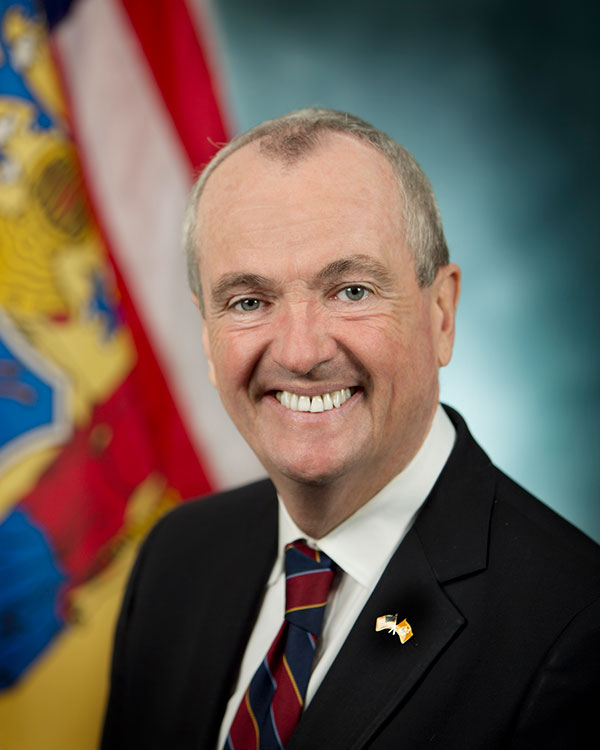
On April 3, Governor Murphy signed into law the Elections Transparency Act, just four days after the Legislature approved it. He did so with no fanfare, which was fitting for the shameful piece of legislation it is. As Matt Friedman wrote for Politico, “Nobody wants to own the Elections Transparency Act.” Murphy held no press conference and issued no statement about the bill becoming law, nor did any of its legislative sponsors. But the newspapers weighed in and they were scathing. The New York Times headline that day read “Gov. Murphy Signs Law Decried as Frontal Assault’ on Good Government,” while an op-ed in the next day’s Bergen Record ran under the caption “Phil Murphy just upended a national ‘model’ for regulating campaign finance.”
The timing was a bit ironic. Just one day before the first former president ever to be charged with a crime was to be arraigned in nearby NYC on charges having to do with violations of campaign finance law, the governor of the state next door was taking an axe to its own ability to rein in campaign finance abuses. Contrary to what the name Elections Transparency Act suggests and however good the original intention behind the law might have been, most of it has nothing to do with promoting transparency. Instead, the law is far more likely to boost the power of big money in New Jersey politics, allowing it to drown out the voices and values of voters, thus undermining our democracy.
The new law does this in a variety of ways, including doubling contribution limits, authorizing additional monies for slush funds (so-called “housekeeping accounts” to pay for administrative expenses) on top of that, and eliminating local pay-to-play laws, while loosening the already lax state-wide standard. It also hamstrings the Election Law Enforcement Commission (ELEC), the hitherto highly effective agency whose job it is to enforce the laws governing the funding of political campaigns in New Jersey. Not only does the law destroy the independence of ELEC by giving the Governor (one time only) unchecked authority to fire and replace all of its commissioners without the usual advice and consent of the Senate, but it drastically curtails the amount of time allowed for ELEC to investigate violations of the law. Even worse, it makes the latter change retroactive, seemingly (and conveniently) tossing out three pending complaints against statewide Democratic fundraising committees along with about 80% of ELEC’s entire docket of pending matters.
The proponents of the legislation, which passed along almost strictly party lines—only four Dems in both houses voted “no” (Senator Nia Gill and Assembly members Dan Benson, John McKeon and Cleopatra Tucker), only six Republicans approved it (Senators Christopher Connors and Vincent Polistina and Assembly members Dianne Gove, Donald Guardian, Kevin Rooney and Brandon Umba) and an initial Republican sponsor, Senator Steven Oroho, took his name off the bill — tended to justify the legislation based on the disclosure provisions. Those provisions are good as far as they go, but any good they accomplish is far outweighed by more problematic aspects of the legislation.
Following the U.S. Supreme Court’s 2010 decision in Citizens United v. FEC, which reversed longstanding campaign finance restrictions and enabled corporations and other outside groups to spend unlimited amounts on elections, huge amounts of dark money have flowed through those so-called “dark money groups,” which need not disclose their donors, and been used to influence elections. Under the new law, donors above a certain threshold will have to be disclosed and the law’s supporters argue that, combined with the increase in campaign contribution limits, that will shift political giving back to candidates and campaigns, who are required to operate more openly.
Here is a closer look at what the Elections Transparency Act (ETA) does. First, with regard to transparency, it requires independent expenditure committees — nonprofit and political groups not tied to a particular candidate, the source of so-called “dark money” — to report to ELEC campaign contributions in excess of $7,500 and all expenditures regardless of amount. A last-minute amendment expanded the definition of “independent expenditure committee” beyond 501(c)(4) nonprofit social welfare organizations such as NOW, ACLU, NRA, and the Sierra Club, to also encompass 501(c)(6) groups, defined by federal tax law as “Business leagues, chambers of commerce, real-estate boards, boards of trade, or professional football leagues . . . , not organized for profit and no part of the net earnings of which inures to the benefit of any private shareholder or individual.” The bill also establishes a cumulative reporting requirement for independent expenditure committees.
Further, it requires candidates and political committees to report campaign contributions greater than $200, down from $300 under prior law, and all expenditures, regardless of amount. There is also a change from 48 hours to 72 hours in the deadlines for reporting certain contributions and expenditures made within a certain period of time before an election though all must be reported within 24 hours in the week prior to election.
That is pretty much it for the transparency/reporting provisions and it is not even clear that those would survive a constitutional challenge. Very similar language in a law enacted in 2018 was struck down by a federal court the following year in Americans for Prosperity v. Grewal, on the ground that it violated the First Amendment. When ELEC Executive Director Jeffrey Brindle testified before the Senate Judiciary Committee on February 23 in support of some aspects of the bill, he cautioned that the disclosure requirements for independent expenditure groups need to be “narrowly tailored” to electioneering activity to ensure that the ETA would be constitutional, unlike the 2018 measure. That was not done.
Opening the Floodgates to More Campaign Cash
Just about everything else in the 68-page bill seems geared toward opening the campaign contribution floodgates and reducing oversight.

The ETA doubles maximum annual contributions from $2,600 to $5,200 per candidate per election and doubles or triples the limit for various committees as follows: State Political Party Committees, $25,000 to $75,000; County Political Party Committees, $37,000 to $75,000; Municipal Political Party Committees, $7,200 to $14,400; Legislative Leadership Committees, $25,000 to $75,000; Political Committees, $7,200 to $14,400, with primary and general elections counted separately; and Continuing Political Committees, from $7,200 to $14,400. On top of those sums, it is now legal to donate an additional $37,500 to a State or County Committees for a so-called “housekeeping” account, to be kept separate from other funds and used for such nonpolitical expenses as rent, utilities, accounting, compliance, human resources and conventions. (Note that this added $37,500 results in an effective tripling of the old contribution limit to committees.) Critics of the bill have aptly slammed the accounts as slush funds.
During the June 27 Senate Budget Committee hearing Sue Altman, Executive Director of the NJ Working Families Alliance, said the big increase in money going to county committees “looks like an insurance policy” against the likely overturning of the county line by giving the county parties more money as a way to retain their power. She was referring to a pending federal court challenge to the unique design of NJ primary ballots, a design that allegedly gives inordinate power to party bosses to predetermine primary outcomes by the placement of certain candidates on a single “county line,” which tends to favor incumbents and other party insiders. The case, Conforti v. Hanlon, 20-cv-8267, was filed in 2020 and is ongoing, with a scheduling conference set for June 13 before U.S. Magistrate Judge Tonianne Bongiovanni in Trenton.
In addition, the ETA more than triples the amount that can be spent on a gubernatorial campaign, from $2.2 million to $7.3 million, and for a joint Governor-Lieutenant Governor campaign, from $5 million to $15.6 million. Going forward, it requires ELEC to adjust the maximum campaign expenditures for all state offices, other than Governor and Lieutenant Governor, every two years.
Supporters of the increases, including ELEC itself, say they are necessary because the limits have not been increased for many years. But during committee hearings, witnesses suggested that even if an increase is appropriate, it should be smaller and more gradual rather than an immediate doubling that opens the flood gates to more influence by big donors and less by everyone else. As NJ Appleseed stated in written testimony it submitted in opposition to the bill:
Doubling contribution limits will simply drive up the cost of campaigning as an arms race between candidates to maximize receipts and election spending will continue. Donors who are not making contributions near current thresholds will be even more minimized in the process going forward, as their donation will represent an even more vanishingly small percentage of a candidate’s receipts.
Assemblyman Brian Bergen (R-Morris) pointed out during a February 23 hearing on the bill before the Assembly Appropriations Committee that the 10 members of that Committee had a collective $1.8 million plus left over in their campaign accounts from the last time they ran, in 2021. Did they really need twice that amount — $3.6 million, he asked rhetorically.
The parties’ most recent quarterly filings bolster Bergen’s point. The Star Ledger reported on April 20 that, as of the end of March, Democrats had $2.5 million in campaign funds on hand, while Republicans had $1.1 million and that these amounts represented the largest first quarter cash reserves held by the six major committees (state and each legislative house for both major parties) in a decade. The Democrats were clearly not hurting for money when they voted to double the old contribution limits and will almost surely be setting new records for quarterly cash hauls going forward.
Eviscerating Pay to Play Protections
The legislation not only allows more contributions but also seems likely to grow campaign coffers even more by weakening pay-to-play (P2P) protections in several ways. Pay-to-play laws, which are meant to ensure the integrity of the public contracting process so that public projects get done by whoever can do the best job at the best price, typically prohibit public entities from awarding contracts to individuals and businesses who have donated money to that public entity, or those who run it, within a certain time frame. Weakening or eliminating P2P protections, as the ETA does, will encourage efforts to obtain government contracts by making political contributions. The work will likely cost more and the odds are higher that it will not be done as well.
The prior state P2P law, in effect since 2006, was already weak on account of the “fair and open” exception, which allowed political donors to obtain government contracts so long as it was done through a so-called fair and open bidding process. Even though the standard applied only to legislative, county and municipal contracts, it still amounted to a sizeable loophole. A 2011 NJ Comptroller’s report entitled Weaknesses in the Pay-to-Play Law’s “Fair and Open” Contracting System concluded that fair and open requirements present “few, if any, real obstacles to a government entity seeking to award a contract to a politically favored vendor.” The Comptroller recommended eliminating the “fair and open” exception entirely, which would create a bright line without exceptions and a more unified approach between state and local laws. Alternatively, the report suggested strengthening the law by various means: requiring use of a qualified selection committee whose members must certify to the absence of any conflict; scoring vendor submissions to ensure a verifiable competitive process combined with requiring documentation and justification of how those criteria are applied and retention of those documents for a certain period; and providing some means to contest how “fair and open” is applied in a particular instance.
The ETA does none of those things. Instead, it expands the “fair and open” exception to the state executive branch and to independent authorities and agencies and also removes the prohibition on donations by contractors to state, county, and municipal political parties and legislative leadership committees. In committee testimony, ELEC Deputy Director Joe Donahue testified that the agency had long opposed the fair and open loophole and its expansion under the ETA “basically makes all contracts fair and open” and ends P2P protections.
In addition, the ETA expressly preempts and thus eliminates all local pay-to-play laws and rules adopted by local governments, which tended to be more stringent than the state standard. There were more than 100 towns in NJ with P2P ordinances, including Camden, Edison, Englewood, Hoboken, Jersey City, Morristown, Point Pleasant, Princeton, Somerville, Teaneck, and Woodbridge. Newark, the state’s largest city has an executive order on P2P issues issued by Mayor Cory Booker in 2006.
Maplewood passed a fairly typical P2P ordinance in 2009, making professional service providers who contribute to elected officials responsible for awarding professional service contracts, their campaign committees or any local political committees, ineligible for such contracts. While the ETA was pending, the Maplewood Democratic Committee issued a statement in opposition to the bill, stating that it “has no place in our government,” and would create even less transparency, “dismantle” the Maplewood ordinance and “newly permit entities with local government contracts to donate to local political organizations,” which “are not values that we believe represent the Democratic party and, by extension, our local Democratic committee.”
In those instances where a local ordinance was adopted as the result of a public referendum, the ETA overrides the express will of voters who sought a higher protection than under state law in order to combat corruption. One town that recently did so is Mount Laurel, where a strict prohibition passed just last year, by a 6-to-1 margin. It is now gone.
NJ Appleseed which has assisted voters in some communities who worked to get P2P ordinances passed in their towns, opposed the ETA based on those provisions as well as others. Executive Director Renée Steinhagen commented on the signing of the legislation:
It appears that with one stroke of the pen, the Murphy Administration, supported by most Democratic legislators, eviscerated local anti-pay-to-play ordinances representing years of activism by ordinary residents of New Jersey. This is nothing less than a slap in the face to those countless activists and is very likely to result in real harm to the ability of voters to hold their municipal governments accountable and responsive to their expressed views, as well as the efficiency and competency of local government.
Legislators have defended the move to get rid of local P2P laws as a way to achieve the uniformity of a single statewide standard, which will generate less confusion. But why seek a uniform state law unless that state law is an effective one? When ELEC Executive Director Jeff Brindle urged an end to the patchwork of local P2P laws in an op-ed last October, he also opined that the fair and open loophole should also be eliminated. To get rid of strong local laws at the same time that the statewide law is not only not strengthened along the lines recommended in the Comptroller’s report, but weakened through expansion of the fair and open loophole, makes no sense and would seem to open the door wider to corruption and undue influence.
Undermining ELEC Independence
Probably the most heatedly denounced provisions of the bill – which have already drawn a lawsuit – are those having to do with ELEC itself. The quasi-independent agency was created in 1973 to monitor the integrity of campaign finances in NJ elections when Gov. Cahill signed into law the Campaign Contributions and Expenditures Reporting Act, codified at N.J.S.A. 19:44A-1 et seq. Because it was understood that an entity like ELEC needed to be shielded from political pressure, it was created within the Department of Public Law and Safety but expressly made independent of any supervision or control by it.
The first commissioners were sworn in in May 1973, two years ahead of their federal counterparts on the Federal Elections Commission, which did not get underway until 1975. The law called for four commissioners, appointed by the governor and approved by the Senate for a term of 3 years, with the governor designating one of them as the chair. None of them can be a public office holder or political party official and no more than two can be from the same party, which has resulted in an even split between Democrats and Republicans over the years. The commissioners themselves have appointed the executive director, counsel and hearing officers, all of whom served at the Commission’s pleasure. They have typically met 11 or 12 times per year and received no compensation for their work beyond a per diem of about $250 per meeting that former Gov. Chris Christie discontinued.
The ETA upends that well-considered and long-established arrangement via a one-time power granted to the Governor to replace the members of the Commission with new appointees who will not need to be approved by the Senate. That power had to be exercised within 90 days of the enactment of the law, thus by early July. The new commissioners get an annual salary of $30,000. During hearings on the bill, Deputy Director Donahue called the 90-day appointment power “unprecedented” and warned it would erode the Commission’s independence and national credibility and undermine the ability to maintain nonpartisanship. ‘’What is the emergency that requires the suspension of the normal statutory procedures?” he asked the legislators. He also wondered if paying ELEC members would subject them to undue influence and thought it could weaken trust in the agency.
NJ Citizen Action’s Maura Collingsru testified that the emergency powers provision is bad policy that sets a bad precedent and sends a message to the electorate that “we can do whatever we want to do,” an especially problematic message from elected officials at a time when our democracy is under great threat. Removing the Senate approval process means the appointments will be done “behind closed doors” and will discourage public input, she noted. Philip Hensley, Democracy Policy Analyst at the League of Women Voters of NJ, pointed out that even though it is a one-time power, the effects could be with us for a long time since commissioners can be held over and remain in place for years.
Allowing Murphy to name commissioners without Senate approval was an eleventh-hour amendment, added on March 23, just one week before final passage. It was the second stab at giving Murphy more control over the ELEC. A prior amendment, on February 23, would have allowed him a direct appointment of ELEC’s Executive Director, taking the choice away from the commissioners though still allowing for Senate advice and consent. But it went even further in undermining ELEC independence by providing that the Executive Director was to “serve at the pleasure of the Governor,” who would also get to decide the ED’s annual salary, up to $175,000. It also required the ED to “devote their entire time and attention to the duties of the office,” language which might seem fairly innocuous but could have provided a cudgel to use on an ED who stepped out of line.
That direct appointment language was part of the ETA when it was scheduled for a floor vote in both houses on February 27. But it sparked such an uproar that the bill was pulled and sent back to committee where legislators decided to replace it with language granting Murphy unbridled power to choose the commissioners who appoint the ED.
Both iterations seem aimed at forcing out long-time ELEC Executive Director Jeffrey Brindle, who has been with ELEC since 1985 and has been Ed since 2009. Murphy had been trying to oust him for months, ostensibly over a snarky and allegedly homophobic email. Referring to a state email that mentioned Oct. 11, 2022 was National Coming Out Day, Brindle had written to an unnamed staffer: “Are you coming out? No Lincoln or Washington’s Birthday’s [sic] but we can celebrate national coming out day.” .” On March 28, just two days before the Legislature passed the ETA and the commissioners resigned, ELEC held a hearing into the accusations against Brindle and determined in a closed-door session that no discipline was warranted.
The legislation was still pending when Brindle sued Murphy, his chief of staff, his chief counsel and his chief ethics officer in Mercer County Superior Court on March 16, alleging a months’ long conspiracy to force Brindle out because of his efforts to shine a light on dark money in politics. The complaint references a satirical op-ed by Brindle in October 2022 that was critical of dark money groups. If Brindle is correct, how ironic that a law purporting to be about promoting transparency is the mechanism for punishing him for expressing his support of transparency, an expression of opinion that is constitutionally protected, at that.
Murphy exercised his one-time power of appointment under the ETA on June 15, naming four commissioners– two Democrats and two Republicans. One is a former NJ State Bar President who practices real estate and environmental law; one is a former state Assemblyman and Navy veteran; another is former President of the Association of Black Women Lawyers of New Jersey and has worked as a prosecutor; and the last is a longtime municipal prosecutor. Brindle’s attorney Bruce Afran told the Star Ledger that the commissioners seemed to be “perfectly capable attorneys but none of them have judicial experience, except in municipal courts, or have actual experience practicing election law, according to the biographies released,” and this “undermines public confidence in this agency’s ability to enforce the law.”
Brindle filed a second lawsuit against Murphy on April 20, seeking to block the ETA on the ground that the provisions regarding ELEC amount to “special legislation” because they specifically targeted him and ELEC. Similar to many other states, the NJ Constitution prohibits special laws that single out an individual or entity for differential treatment. N.J. Constitution, art. IV, §7. The N.J. Supreme Court stated in Robson v. Rodriguez, 26 N.J. 517 (1958), that “a law is special in a constitutional sense when, by force of an inherent limitation, it arbitrarily separates some persons, places, or things from others, upon which, but for such limitation, it would operate.”
When Murphy’s handpicked commissioners met for the first time on July 25, they surprised many by not removing Brindle as ELEC Executive Director. Less than a week later, however, on August 1, attorney Afran stated that Brindle would retire of his own accord on November 30, 2023, and that it had been his plan to do so for a while but he had held off announcing it in the face of the Governor’s efforts to oust him. Despite the retirement, both of Brindle’s lawsuits will continue, according to Afran.
Speeding up the Clock and Tossing Out Complaints
The ETA not only messes with the independence of ELEC but also with its ability to do its job.
Under prior law, ELEC had 10 years to investigate alleged violations of campaign finance law and bring enforcement actions. ETA slashes that to a mere two years. Ten years might have been too long. After all, ELEC’s federal counterpart, the Federal Elections Commission has a five-year statute of limitations which seems about right given that that election cycles are typically longer than two years and investigations often require a lot of time to delve into financial transactions that can be complex and well-hidden. But two years? Donahue told legislators the two-year time limit would have a “devastating” impact on ELEC’s enforcement capability.
What makes it even worse than simply bad public policy is that the shortened two-year time limit is retroactive. That is widely understood to mean that it is not just future complaints that cannot be brought outside that time frame but that many existing complaints and probes are effectively thrown out or shut down. During committee hearings. ELEC’s Donahue testified that the retrooactivity provision would knock out about 80% of pending complaints.
One who does not share the view that the two-year limit necessarily has retroactive effect is Brindle attorney Afran. He says the lawsuit over the provision alleges that because ELEC was delegated independent enforcement power, the Legislature can subject future cases to the truncated statute of limitations but cannot retroactively undo ELEC’s prior decision to commence cases under the prior time frame. “This is a novel legal question that will have to be litigated,” he adds.
It seems significant that if the ETA does operate retroactively, as intended, the complaints that vanished with the stroke of Murphy’s pen included complaints against three major NJ Democratic party committees (and their treasurers): the Democratic State Committee, the Senate Majority Committee and the Assembly Campaign Committee. The complaints alleged that the committees cumulatively failed to report a combined $875,000 plus in contributions and more than $1.1 million in spending in 2017, an election year in which every seat in the state Legislature was on the ballot and Murphy was elected to his first term as Governor. The complaints were filed on January 4 of this year, well past the new, retroactive two-year time limit, so if is retroactive, they were gone the moment that Murphy signed the ETA into law. Given that the penalties for the three complaints could have run into hundreds of thousands of dollars, it is hard not to see the change in the statute of limitations, or at least the retroactivity aspect, as a kind of get-out-of jail card that Democrats voted for themselves. It is even harder to see it as anything else in the face of recent revelations, first reported in the Bergen Record on April 18, that Senate President Nick Scutari failed to disclose details about $600,000 in campaign expenses over the past 15 years. Scutari was the ETA’s chief sponsor.
Consequently, the ETA not only tosses out existing cases but will hamper ELEC going forward. It is not only that there will be less time to act on a violation but that the reduced window for action could incentivize those facing an ELEC investigation to delay it in order to run out the clock. Legislators have promised more funding for ELEC. Let’s see if they actually come through on that.
What was also gone even before Murphy put pen to paper was ELEC itself, at least the three individuals who sat on the commission. (There are supposed to be four commissioners but Murphy has been notoriously poor when it comes to filling empty seats, or in the case of unfilled judgeships, empty benches.) The three members of ELEC—Chairman Eric Jaso, and members Eric Holden and Marguerite Simon—resigned en masse as soon as the Legislature gave final approval on March 30. Jaso’s letter of resignation to Governor Murphy said of the ETA that it “would largely gut ELEC and—ironically—render it unable to further its missions of transparency and accountability.” He further stated:
[T]his ill-advised legislation, enabling a ham-handed exercise of Executive power where back-room arm-twisting failed to achieve your immediate political goals, at least undermines and at worst destroys ELEC’s hard-earned public perception of independence, transparency and freedom from political influence.
Matt Friedman, who writes Politico’s New Jersey Playbook letter, was probably not overstating things when he referred to the ETA as the “ELEC death bill.”
At its initial meeting on July 25, the new ELEC’s first action was to dismiss 107 campaign finance complaints that had been pending more than two years.
Emulating Christie?
Murphy is not the first governor to interfere with the effective operation of ELEC. When Essex County Executive Joe DiVincenzo was facing ELEC charges over his alleged misuse of election funds –travel to Puerto Rico, expensive dinners, tennis and baseball games in NYC, etc. — Governor Chris Christie’s failure to fill vacant ELEC seats caused an administrative judge to throw out the case because ELEC lacked a quorum. It got to the point where death and departure reduced ELEC to a single member, rendering it inoperable for roughly a year, until Christie began appointing, and the Senate approving, new members in 2017.
One final provision that has not drawn much notice would allow public officeholders, candidates and committees to use campaign funds for legal fees and litigation costs “arising from campaign activities.” That would presumably encompass petition challenges, recount requests and other election challenges. It would not extend to costs and fees for defending against corruption charges. New Jersey’s Supreme Court held in 2008 that state Senator Wayne Bryant could not use campaign funds to defend federal corruption charges because that did not fall within his usual responsibilities as a public official. The issue arose again when former Newark Mayor Sharpe James tapped campaign monies to defend himself against federal fraud charges. A state appeals court held in 2015 that he was not entitled to do so and required him to repay the money.
A cynical person might think that Christie was rewarding DiVincenzo for crossing party lines in 2013 to endorse him for reelection over Democratic gubernatorial candidate Barbara Buono. After all, it was the failure of Fort Lee Mayor Mark Sorokin, also a Democrat, to emulate DiVincenzo in backing Christie for a second term that allegedly led to the Bridgegate scandal, which involved the blocking of local access lanes to the George Washington Bridge in Fort Lee. Note to Murphy: That did not turn out well for Christie. Though he was never criminally charged, his popularity plummeted, not long after he had won reelection with more than 60% of the vote and his hitherto promising presidential prospects evaporated and never recovered.
A Democratic Power Play—Public Opposition Be Damned
The problems with the ETA law go beyond its substance to the manner in which it was enacted. As originally proposed, the name was not quite so much of a misnomer because the bill had disclosure provisions, along with bipartisan support. But amendments added late in the process, especially those regarding ELEC and P2P, seemed to have been done in a way designed to thwart public scrutiny, as a broad array of groups lined up to oppose it and the state’s leading newspapers uniformly inveighed against it in a series of scathing editorials. Opponents – and by opponents, I mean basically everyone because no member of the public who testified or submitted a slip expressed support for the bill beyond its disclosure provisions – showed up at committee hearings to testify only to learn while the hearing was underway, or even when it was effectively over, of additional amendments. ELEC, which started out supporting the bill because of the disclosure provisions, which were drawn pursuant to its recommendations, ended up largely opposing it to the point of en masse resignation.
Among those who testified against the bill or submitted slips in opposition were good government, civil liberties and social justice groups, environmental organizations and unions, including: the League of Women Voters of New Jersey, NJ Citizen Action, NJ Institute for Social Justice, Latino Action Network, NJ State League of Municipalities, NJ Policy Perspective, Blue Wave NJ, Central Jersey Progressive Dems, NJ Working Families Party, Local 32BJ of the Service Employees International Union, the NJ League of Conservation Voters, Environment NJ, ACLU-NJ, Our Revolution NJ, Salvation and Social Justice, League of American Families and NJ Appleseed Public Interest Law Center. No one spoke in support of the legislation as a whole. The outcry against the bill was so strong, the criticism so withering, that it was pulled at the last minute on February 27, when it was scheduled for a floor vote in both houses. It was sent back to committee for minor changes that did little, if anything, to alleviate the problems with it or allay the legitimate concerns about it.
At a time when advocates for democracy bemoan efforts by Republicans across the country to gain or hold onto power by drawing gerrymandered districts and suppressing votes, it is disheartening and infuriating to see the Democrats who control this state also undermining democracy, albeit in a different way.
As Matt Dragon Tweeted after Murphy signed the bill into law:
We are literally in a struggle to keep democracy alive. One party can’t win elections anymore, so they gerrymander, disenfranchise voters, & then lie about voter fraud and election results when they still lose. The other party looks at that landscape, turns around and own goals it.
Near Universal Condemnation – What Press and Pundits Said
What follows here is a collection of news articles and op-eds about the Elections Transparency Act, some of which also appear above. I apologize to anyone who might not be able to access some of them due to subscription firewalls. I hope you at least get the gist from the headline.
New York Times
Gov. Murphy Signs Law Decried as a ‘Frontal Assault’ on Good Government, Tracey Tuli, April 3, 2023
Bergen Record
Did Phil Murphy embrace Trumpist tactics in push to muzzle ELEC?, Charles Stile, March 6, 2023
NJ Senate passes money in politics overhaul that would give Murphy sway over election watchdog, Ashley Balcerzak, March 20, 2023
Here are the major changes in the NJ Elections Transparency Act, Ashley Balcerzak, March 21, 2023
Move to weaken election commission is NJ Politics at their worst, Charles Stile, March 21, 2023
NJ ELEC Commissioners resign after Elections Transparency Act is passed by Legislature, Katie Sobko, March 30, 2023
Oh, the irony: the Elections Transparency Act defangs NJ’s election watchdog, USA Today Network NJ Editorial Board, April 1, 2023
Murphy signs disputed election finance bill that gives him more power over watchdog agency, Ashley Balcerzak, April 3, 2023
Opinion — Charles Stile, Phil Murphy just upended a national ‘model’ for regulating campaign finance, April 4, 2023
NJ Senate President Scutari failed to disclose details of about $600k in campaign expenses, Ashley Balcerzak, April 18, 2023
Opinion — Charles Stile, NJ ELEC just tossed 107 cases. What did we expect from ‘reform’?, July 31, 2023
northjerseynews.com
Opinion —Murphy’s Tired Act on Transparency, March 26, 2023
ELEC Commissioners resign ahead of new bill, Nathan Resso, March 31, 2023
Star Ledger
Opinion — A slippery stunt by Democrats to defang the election watchdog, Tom Moran, February 26, 2023
N.J. Democrats fast-tracking bill critics say will gut independent election watchdog. Is it politics? Matt Arco, February 27, 2023
N.J. Dems delay action on controversial bill critics say will gut independent election watchdog, Matt Arco, February 27, 2023
Opinion — This is what politicians do when they don’t respect you, Assemblyman Brian Bergen (R), March 15, 2023
Independent election watchdog sues Murphy for trying to force him out. ‘It’s political thuggery,’ Susan Livio, Matt Arco and Brent Johnson, March 16, 2023
Controversial N.J. campaign bill that’s already prompted a lawsuit passes state Senate, Brent Johnson, March 20, 2023
Democrats in raw power move, try again to torpedo election watchdog, Star Ledger Editorial Board, March 26, 2023
Editorial — Murphy’s Law: Slime detractors, grab the power, March 30, 2023
Opinion – ELEC Director’s emails reeked of bias, partisanship and disrespect, Christian Fuscarino, April 7, 2023
NJ election watchdog sued Murphy over controversial campaign money law, Matt Arco, April 20, 2023
Opinion – Scutari’s get out of jail free card, Tom Moran, April 20, 2023
Murphy replaces N.J. election watchdog board, which could pave way for director’s ouster, Matt Arco, June 15, 2023
Election watchdog Murphy targeted for firing will retire Nov. 30, Susan K. Livio, Aug. 1, 2023
Politico’s NJ Playbook
Bill to defang N.J. campaign finance watchdog stalls, Matt Friedman, February 27, 2023
Brindle sues Murphy, three top aides after effort to oust him from ELEC, Matt Friedman, March 16, 2023
The ELEC death bill, I mean Elections Transparency Act, progresses, Matt Friedman, March 21, 2023
The end of an era for ELEC, Daniel Han, March 31, 2023
Nobody wants to own the Elections Transparency Act, Matt Friedman, April 4, 2023
NJ Monitor
Commentary — Transparency claims of campaign finance bill are laughable, Terrence McDonald, March 17, 2023
Critics slam lawmakers’ push to raise campaign donation limits, Nikita Biryukov, March 30, 2023
Commentary — NJ lawmakers do not need more cash from campaign donors, Terrence McDonald, April 3, 2023
Advocates see few upsides to recent pay-to-play overhaul, Nikita Biryukov, April 10, 2023
NJ Globe
Here’s everything that the ‘Elections Transparency Act’ would do, Joey Fox, February 24, 2023
ELEC head sues governor over attempt to oust him, Joey Fox, March 16, 2023
ELEC will hold public hearing on Brindle next week, Joey Fox, March 21, 2023
ELEC commissioners will not discipline Brindle over insensitive email, Joey Fox, March 28, 2023
ELEC commissioners resign, preempting bill that would force them out, Joey Fox, March 30, 2023
Assembly leaders say they’ll introduce bill to increases ELEC funding, Joey Fox, March 30, 2023
ELEC releases eight complaints — all of which are nullified by new campaign finance law, Joey Fox, April 5, 2023
ELEC’s new leadership will have the power to reshape 2025 gubernatorial fundraising, Joey Fox, April 11, 2023
Insider NJ
Regulatory Capture: Murphy’s Crew Target NJ ELEC Chief, Bob Hennelly, March 20, 2023
Murphy’s ELEC Albatross, John Van Vliet, April 4, 2023
Has the FBI Noticed Trenton’s Rush to Shut Down NJELEC Cases?, Bob Hennelly, April 5, 2023
 NJ Appleseed
Renee you could have helped me but you chose to ignore and turn a blind eye just like Buckman. He turned and ignored me. He died mysteriously. It’s sad
LikeLike